
Let's address the elephant first
Your partner isn't actually afraid of the vibrator. They're afraid of what it represents. Inadequacy. Replacement. The unspoken worry that you're turning to a toy because they're not enough. Most relationship tension around toys has nothing to do with the toy itself and everything to do with what it symbolizes about desire, performance, and whose job it is to satisfy you.
The good news? That's completely fixable once you understand the fear underneath.
Why partners resist toys in the first place
Most people who feel threatened by vibrators are operating from one of three beliefs:
1. "If you need a toy, I'm failing." They've internalized the myth that good partners produce orgasms without assistance. When something like a lemon clitoral vibrator enters the picture, it reads as a report card on their performance.
2. "You'd rather use that than me." This is the replacement anxiety. He (or she, or they) worries that the toy will become the preferred option and they'll become irrelevant during partner sex.
3. "I don't know what my role is anymore." Toys introduce uncertainty about what he's supposed to be doing with his hands, his body, his attention. The script changes and nobody told him.
None of these beliefs are true. But they feel true to the person holding them. That's why you can't logic someone out of toy resistance. You have to acknowledge the fear first.
The conversation to have before the toy appears
Don't surprise them. Don't order a lemon vibrator and hope they'll be okay by the time it arrives. Have the conversation when you're both clothed, not aroused, and neither of you is defensive.
Start with reassurance, not the toy. Try: "I want to talk about something without you feeling like I'm criticizing you or saying something's wrong. Because nothing's wrong. I just know my body takes a while to orgasm with a partner, and I want to explore that."
Notice what you're doing: you're not blaming him. You're naming a fact about your body. You're owning your arousal.
Then: "I've been reading about clitoral vibrators, and I think it might help me come during sex instead of feeling like I'm chasing it. I want to try this with you, not instead of you."
Wait for him to respond. Don't fill silence. Let him ask questions. Most of the time, he will.
If he says something like "Why can't I just do it?" or "Am I not enough?" this is the moment to separate two things. "You're absolutely enough for what you're great at. This isn't about you being inadequate. It's about my body and how it's wired. Some people come quickly with stimulation. I'm wired differently. A tool helps with that."
Then offer specificity: "It doesn't replace what we do. It's something we'd use together sometimes."

Photo by Diana ✨ on Pexels
Reframe what the toy actually does
This is where most couples get it wrong. They position the vibrator as a replacement for partnered sex. It's not. A lemon clitoral vibrator isn't a substitute for your partner. It's a tool that lets you experience more sensation during the sex you're already having together.
When you introduce it, frame it this way: "I want you to be part of this. I want to feel you while I'm using it. I want your hands on me, your attention on me. The vibrator is just helping my body respond faster so we can be on the same page."
Then follow through on that promise. When you use it, have him involved. Let him hold it sometimes. Have him be the one to apply it while he's inside you or beside you. Make it collaborative, not isolated.
This does three things. First, it keeps him in the experience instead of feeling sidelined. Second, it proves the toy isn't replacing him. Third, it often makes the experience more arousing for both of you because now there's novelty and partnership and shared exploration.
The actual introduction (step by step)
You've had the conversation. He understands the why. Now here's how to make it feel natural instead of awkward.
Don't make the first time a big production. Don't schedule it like a medical procedure. Let it come up naturally during foreplay. "Hey, I want to try that thing I mentioned."
Start with him watching while you use it on yourself. This does critical work. He sees you respond to it. He sees it's not replacing him. He watches you feel pleasure. Most partner resistance dissolves when someone actually sees that the toy is making their partner feel good.
Keep it simple: 2-3 minutes, lower intensity settings (start on pattern 1 or 2 with a lemon vibrator), your hand guiding it. Narrate what you're feeling, not because he needs coaching but because it keeps him connected to your experience.
Then: "Now I want you to touch me while I use it." His hand on your hip, your breast, your face. His presence. Gradually, he gets comfortable holding it while you guide him. Eventually, he might use it on you while you focus on feeling. There's no rush.
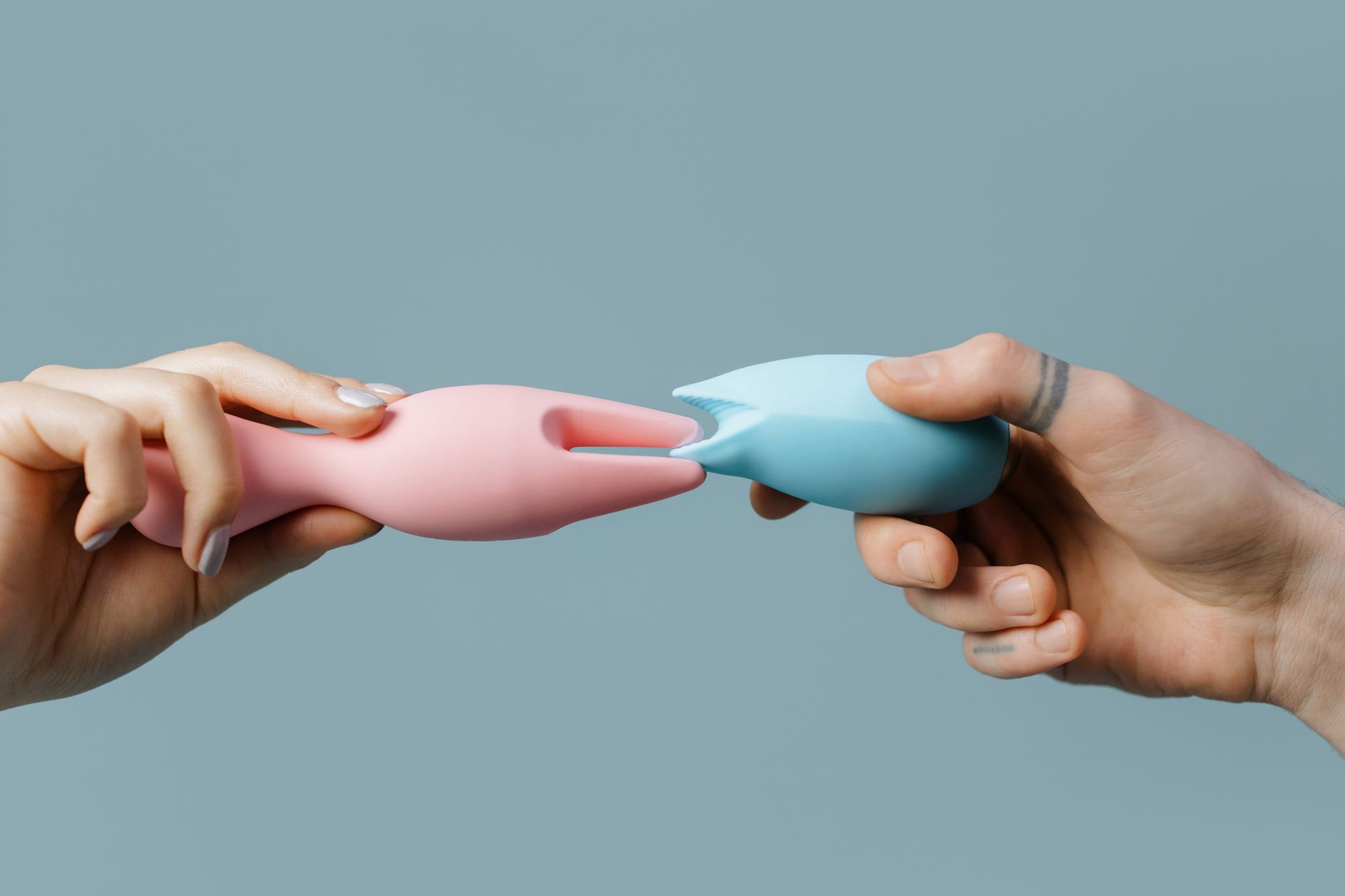
Photo by cottonbro studio on Pexels
What to do when he still resists
Some partners won't come around immediately. That's information you need to sit with, not something you should steamroll past.
If he's still uncomfortable after the conversation and a gentle first experience, you have three options.
One: Ask what specifically makes him uncomfortable. Is it visual? Is it the sound? Is it that he feels sidelined? Different fears need different solutions. If it's visual, you can use toys during solo time instead of partnered sex. If it's the sound, quieter toys exist. If it's that he feels sidelined, you can restructure how you use it together.
Two: Suggest you explore it alone for a while. Let him get used to the idea gradually. Sometimes partners come around faster when they're not in the middle of the experience.
Three: This might be a deeper conversation about compatibility and what you both need. If he's unwilling to support your pleasure even after understanding it, that's not really about the toy. That's about whether he respects what you want for your own body.
The long game
Once your partner sees that a lemon clitoral vibrator actually works, once he feels how different sex is when you're both satisfied, something shifts. He stops thinking of it as competition and starts thinking of it as something that helps both of you. Some partners even become the ones advocating for using it because they like what it does for the experience.
You're not asking him to be replaced. You're asking him to be part of something that makes sex better for you both. Once he understands that distinction, most of the resistance fades.
This isn't about convincing someone to do something they hate. It's about helping them understand that your pleasure matters, that toys don't threaten partnership, and that sometimes the best sex involves admitting that both partners have different bodies with different needs. That's not failure. That's actually the beginning of real intimacy.
People also ask
How do I know if my partner will ever be okay with toys?
Listen to what he says when you bring it up. If it's "I need to think about it," that's a maybe. If it's "I don't like the idea but I trust you," that's movement. If it's "Absolutely not," paired with unwillingness to talk about why, that tells you something about how he handles your needs when they conflict with his comfort. One hesitant conversation isn't a dealbreaker. Repeated refusal to even discuss your pleasure is different.
Can I use a lemon vibrator during partner sex without asking permission first?
Not if you want the experience to actually be good. Surprises usually backfire. He feels ambushed. You feel like you have to hide it. That's the opposite of the trust and openness you're trying to build. The conversation is the gift you give to both of you. It signals that you value his input and that you're partners solving this together, not you doing something to him.
What if he wants to use the vibrator but I don't want him to?
That's completely valid. You get to set boundaries around your own body and how it's touched. If he's pushed past your yes into your no, that's worth addressing separately from the toy conversation. But if he's enthusiastic and you're nervous about handing over control, try guided practice. Let him hold it while your hand is on top of his. You control the pressure and angle. He gets to participate. Everyone feels safer.
Is it weird that using a lemon vibrator with my partner feels more intimate than using it alone?
Not at all. When someone else is present and engaged with your pleasure, it changes the neurochemistry. You're not just experiencing sensation. You're being witnessed. You're being supported. That's deeply intimate. Some people find partnered toy use actually deepens connection because there's vulnerability and trust happening on both sides.
What if I orgasm with the toy but couldn't with my partner before?
That doesn't mean your partner is bad at sex. It means your body responded to a specific type of stimulation. Communicate that clearly. "I can come with this because my body responds to this particular sensation. That doesn't mean the sex we have without it is bad. It means I was working too hard and now I'm not." Then keep using it together so he can feel the difference in how you're present during sex.
How often should we use toys during partner sex?
As often as you both want to. There's no rule. Some couples use toys every time. Some use them occasionally. Some use them when one partner needs more stimulation than the other is providing. The point is you're choosing it together. If you're using it because you feel like you have to hide something he wouldn't like, that's a sign the underlying conversation didn't actually land.
The bottom line
Toys aren't about inadequacy or replacement. They're about expanding what's possible between two people. A lemon vibrator doesn't fix a relationship with communication problems. It does create an opportunity for honest conversation about desire, pleasure, and what both of you actually need. Sometimes that conversation matters more than the vibrator itself. The tool just gives you permission to have it.
If you're ready to move forward, start with the conversation. Everything else follows from there.
Have questions about navigating this with your specific relationship? Reach out and let's talk.
Sources
Gottman, J. M., & Silver, N. (2015). The Seven Principles for Making Marriage Work. Harmondsworth: Penguin Books.
Perel, E. (2018). Mating in Captivity: Unlocking Erotic Intelligence. New York: HarperCollins.
Breauer, L. (2020). The Joy of Sex in Midlife and Beyond: A Comprehensive Guide. Tantor Media.